
One hypothesis of the D2C founder is that humans will be replaced with Drones for last-mile logistics, bringing the last-mile cost down from Rs 30-40 to Rs 3.
But,
Drone delivery in India~ great concept, broken economics. ( For Now atleast)
The basic math problem:
A delivery drone costs lakhs to buy and operate. To make money, it needs to do 200+ deliveries per day. Today’s average across Indian operators? 3 to 8.
Every delivery is still losing money.
Cost reality check:
Ground delivery in India~ Rs 40–80 per order. Drone delivery in India today~ Rs 250–400 per order. No D2C customer is paying that premium when Blinkit delivers in 10 minutes for Rs 25.
Why it works in the US but not here:
In the US, road delivery costs $7–10 per package. Drones at $13–15 are starting to compete. The gap is closing. In India, road delivery is already the cheapest in the world. Drones have nothing to displace.
++: Indian cities are vertical and dense with no obvious landing zones, BVLOS (beyond visual line of sight) flying still needs route-by-route government approvals, and ground-floor logistics infrastructure for drone pods barely exists.
Where drones actually make sense in India right now:
~ Healthcare: blood samples and medicines to remote clinics where there’s literally no road alternative
~ Hub-to-hub: moving inventory between dark stores, with a bike handling the last 200 metres to the doorstep
~ Remote India: hilly terrain, flood-prone zones, Naxal-affected districts — India Post already piloted this in Gadchiroli.
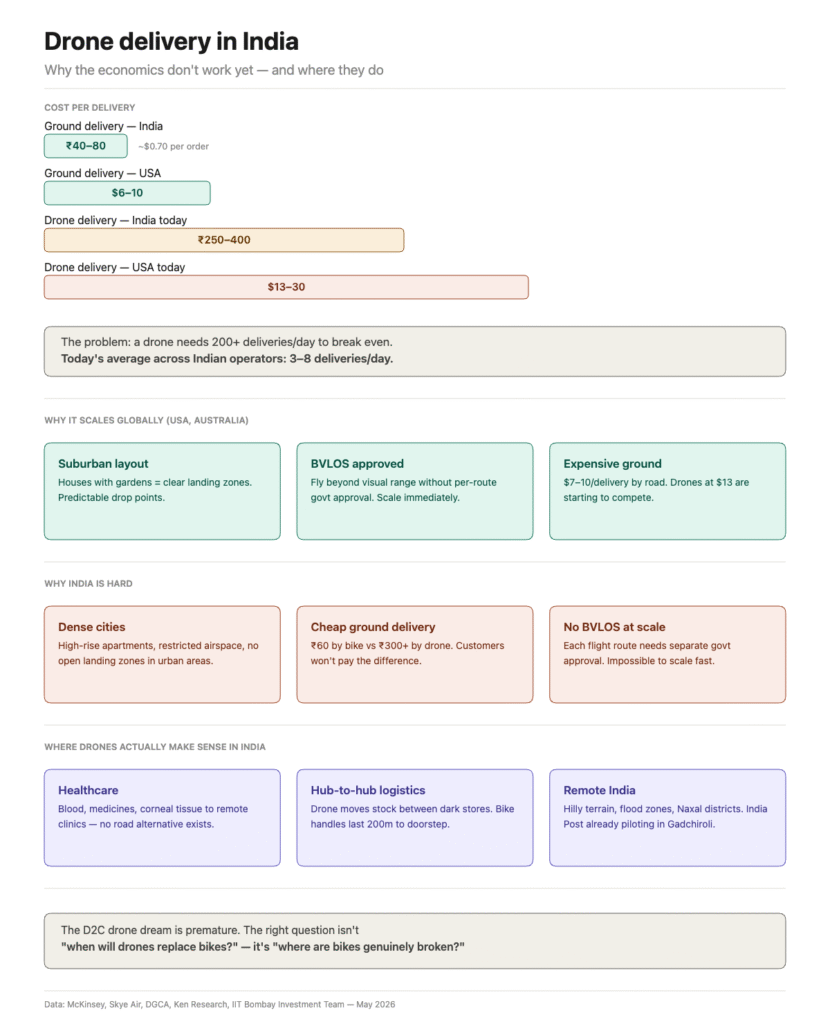
The D2C dream is premature.
Skye Air did 20 lakh deliveries in 2025 — impressive. But they still use a human “walker” to hand off from the drone pod to the customer’s door. That’s not a bug, it’s a compliance workaround. Full autonomy isn’t here yet.
The real question for Indian logistics isn’t “when will drones replace bikes?” It’s “where are bikes genuinely broken?”